The Green Zone

The Green Zone

The mind is an unusual thing. Unlike our hands, lips or eyes, our minds aren’t quite as easily controlled. At times they take off on their own, regardless of what we may, or may not, want our minds to do. Thinking, “Grab that cup of coffee,” always works for me. But thinking, “I want to feel better right now,” rarely works in the same way.

So what can we do? How can we tame our feelings when they are out of control? How do we stop destructive thoughts that recycle over and over, like a merry-go-round in our brain?

Here’s my solution: once I’m aware of what’s happening, and I’ve decided I want it to stop, I pick up my bag of recovery tools and inject a strong dose of the solution from each tool into my mind.

Like an engine revving too high, way into the red zone (where everything is NOT okay), I need to bring it back down into the green zone (where everything runs smoothly), before it blows up my life.

Each of the tools I employ are designed to get me out of anger, hopelessness, worry and a feeling of victimization and return me to a place of gratitude, hopefulness, peace and a feeling of abundance.

The actions I’m speaking of are outlined here in this website and in many of my blog posts. Each one is an actual concrete, physical action that requires me to stop what I’m doing and invest time into using the tool, which then results in a positive shift in my perception.

I no longer need to sit around when my mind is thinking about upsetting things, or when I’m feeling down. I’m not interested in being unhappy for even one extra second than I have to. The program offers me a huge array of options to get out of misery and into happiness. And I can do it as quickly as I want, whenever I’m ready.

My feelings and thoughts are not the result of what others are doing to me, or what’s happening in my life—that’s a lie I used to tell myself to play the victim. I now recognize that I have 100% control over my thoughts and feelings. Not 99%, 100%.

The faster I recognize my discomfort, shut my mouth, grab my tools and get back in the green zone, the less destruction I create for myself and others, the more fun I get to have, and the faster I get back into the place where… ILML!

—JamieQ

Getting in the GZ

“God, please help me to want what you want.” – Hope for Today

This reading talks about perceiving the idea of turning our will and life over to God, as our 3rd step suggests, in a way that doesn’t mean giving up our will. Instead, it says that “Developing a healthy relationship with my Higher Power is about teamwork,” and also encourages us to align our will with God’s.

That’s why the prayer above is such a great one for me. You see, I honestly believe that God’s will for me is to be happy, joyous and free. I think my HP wants me to experience unlimited abundance and love, and then share it with everyone I can. If that’s the case, of course I want exactly what God wants for me. Wouldn’t you?

When I’m in the God Zone (something Chris, one of my sponsees, put on his gratitude list today, I’m really wanting exactly what God wants for me, and… ILML!

— JamieQ

A Concrete Set of Actions

A Concrete Set of Actions

“Beginning with childhood, we all receive messages that… we must have… possessions, and prestige to be happy… giving what we have to help someone else makes us a lot happier…” – In God’s World

I often share this exact sentiment with others, something I’ve experienced first hand. After graduating college, I found myself working at a big company, wearing a 3 piece suite, driving a Mercedes 230SL, in what I considered a healthy romantic relationship and living in my newly owned co-op that I had recently renovated. Guess how I felt? You got it… unhappy, unfulfilled, and confused as to why I wasn’t happy. By the way, I was sober too, and had been for a few years.

What was missing? Oh, just about everything the program offers. Fellowship, a working knowledge of the steps, using the program’s principles in all my affairs, comfort in finding my part when upset and making amends quickly, an understanding of, and great relationship with, a higher power of my understanding, and perhaps most importantly, the desire, ability, and commitment to share what I learned in recovery with others (which at that time was nothing), helping to positively contribute to their lives. When I started putting all the other pieces together, that last part gave me the added gifts of both friendship and intimacy.

So what about money, property and prestige? Isn’t that important? Why can’t I have those too?

Well, of course I love those things–I’d be a liar if I said otherwise. Having money gives me a perception of financial security I long for and often feel I don’t have. Owning a house does the same thing, along with eliminating the fear of being evicted by a landlord or having my rent increase. Owning a nice car makes me feel good, is comfortable, and takes away the fear of not being able to get somewhere easily or dependably. And prestige? Well, I’ve discovered that I do care what others think about me–in spite of that often heard saying “What others think about me is none of my business.” But rather than wanting them to think I’m financially successful, it makes me feel much better to have them think I’m a kind, loving, helpful, emotionally stable, happy life lover. And that they know I’m aspiring to be a great husband, father, brother, son, sponsee–in truth, a great man. The money and things are great, but I believe they come (in the perfect amount and at the perfect time) when I work my program.

And speaking of working my program, I just wanted to say that for me, the program is more than meetings and calling my sponsor. I did that for years and it wasn’t enough – honestly I felt lost. I also sponsored others during that time, doing the two-step dance, and I wasn’t loving my life.

Today I’ve developed a concrete set of recovery actions that help me become the best man I can be, and experience the most emotional comfort I can have. That list includes:

• Attending at least 3, but preferably at least 4, meetings a week – one being an AlAnon meeting, and (if possible) one being a Double Winners meeting.

•  Staying in communication with my sponsor, particularly when I’ve tried all other program solutions and still feel lost and/or confused.

• Reading recovery literature, and being sure to highlight in, and write at the top of, the pages I read each day.

• Writing recovery posts and texts like this, sharing them both on my blog and in texts to my core recovery group.

• Writing and sharing gratitude lists with others

• Making my bed daily

• Entering and exiting my bed from my knees where I connect with source

• Journaling with a pen and paper to take my inventory and examine the areas of my life I love and those I’d like to work on or surrender to my higher power.

• Making time to listen to affirmation-oriented loving meditations.

• Being productive toward making, and maintaining, myself as a financially self-supporting individual.

• Keeping my thoughts, efforts and physical surroundings organized to maximize my efficiency and sense of comfort.

• Engaging in hobbies that feed my creativity.

• Eating sensibly and healthily, but giving myself permission for occasional indulgences as a reward for being fit.

• Making time to get close to, and appreciate, the awesome nature that surrounds me.

• Being of service to others without monetary compensation, both in group settings, and one-on-one.

• Exercising my body by stretching and getting pushing my body to places that make me breath hard and both exercise my heart and keep my muscles strong.

I’m not perfect. I don’t get all  of them done every day. I fall short of perfection. However, the more discipled I am about practicing these actions on a daily basis, the less uncomfortable I am when my expectations are unmet by others, or when situations don’t turn out as I hope, and the more… ILML!!

– JamieQ

Finding Our Life’s Purpose

Finding Our Life’s Purpose

“One day, the lightbulb is going to go off in your head. You will become aware of what you are destined to do in life.” — Until Today

When I was a child I remember hearing people ask me the question, “What are you going to do when you grow up?” I heard that same question when I was in college, in my junior year. I was forced to pick a major, and for me that meant figuring out what I was going to do with my life. Of course, at 20 years old, I still had no idea.

I’ve worked a ton of jobs. I got married. I had kids. But none of those things (work, being a husband, or being a daddy) answered the question Iyanla Vanzant poses in her book: “What am I destined to do in life?”

The Big Book of Alcoholics Anonymous says, “Our real purpose is to fit ourselves to be of maximum service to God and the people about us.” I was shown that line and told that if I could stay sober and help a few other people out each day, that by the time I lay my head on the pillow at the end of the evening, I’ve fulfilled my purpose and I am a huge success in life.

Wait, what? You mean I don’t have to make a ton of money to be successful? I don’t have to get out from all my debt? I don’t have to make my parents proud? I don’t have to give my wife and kids everything they desire every time they want it? I don’t have to have a new car or own a home to be a success? Correct.

All of those things come and go. Days pass and sometimes we achieve the material goals, sometimes we don’t. Some days we make everyone happy with us, some days we don’t. It’s time that we separate achieving those goals from our definition of success and happiness.

One of the reasons I love my life so much and I’m so happy is that I truly bought into that idea in the big book. All I need to do is stay sober (physically and emotionally), and be of maximum useful service to others, and I’m a huge success.

Sure, having nice things and making people happy always makes me feel good. The problem is when I become too attached to those results, then unhappiness follows when I don’t achieve them.

So today I’ll live in the moment, take extra good care of myself, and be there to help others when possible. When I keep things simple like this… ILML!

— JamieQ

How to Live a Great Life

How to Live a Great Life

“Al-Anon is like physical therapy for my soul, aligning my principles and behavior so that I can move joyfully through life!” — The Forum, March 1988, Hope for Today

What a wonderful analogy. This morning I did my mediation, prayers, and affirmations, leaving myself feeling spiritually centered.

Then I got up, made my bed, straightened my house, leaving myself feeling clean and organized.

Then I did my yoga, ran some wind sprints, lifted some weight and ran through some body core exercises, leaving myself feeling strong and healthy.

Then I showered, shaved, dressed nicely, groomed myself and drank a bunch of water, leaving myself feeling refreshed, handsome and hydrated.

Now I’m at Starbucks, doing my journaling, sending out my gratitude list, writing this blog post, reading from my spiritual backpack and infusing my mind with AlAnon ideas and principles, leaving myself feeling joyful and open to the abundance of the day.

In a little while I’ll be at a job I love to do, which also provides a great service to others, leaving myself feeling productive and self-supporting.

Later today I’ll stop working for a bit, play guitar and drink tea with my friends and brother, who are all in the program, sharing hobbies and fellowship, leaving myself feeling a sense of community, belonging and love.

After writing this all down, it’s evident to me why I love making the program a central and integral part of my life. It’s also easy to see why… ILML!

– JamieQ

Accepted, Surrendered & Grateful

Accepted, Surrendered & Grateful

“Thank you, Higher Power, for this beautiful day… Place in my path some way to serve others… May I feel your presence today…” – 12 Step Prayer Book

Lately, I’ve been in the groove. The spiritual, recovery, life loving groove, that is. And it’s odd because my General Manager quit on Tuesday, March 27th, and we are on deadline at work – usually a time when we are severely overworked and need everyone’s help. In this situation it would be completely understandable to be panicked or upset. Interested enough, I’ve being feeling happy, excited and optimistic. So what’s up?

Here’s what I think it is. On March 19th, just 8 days before she quit, one of my sponsees (Chris H) let me know he was starting the 21 Day Oprah Deepak Meditation Challenge, and I decided to join him. Prior to doing the daily morning meditation, both Oprah and Deepak talk about how to change our attitudes in order to perceive both life and ourselves in a very positive, uplifting way. Inspirational and optimistic, each morning these meditations have the affect of opening me up for abundance.

While those who love me are calling to express their deep concern about losing my manager while on deadline, I repeatedly tell them that I’m feeling better than ever about work and being able to handle it all easily myself, without any help at all. Of course, if the opportunity to find someone who’s a good fit comes along, great. If not, that’s great too. I’ve fully accepted, surrendered and am grateful for all of it.

This attitude that everything is perfectly fine and under control is not an illusion. The company really is doing great and I’m accomplishing twice as much with half the effort (I even snuck out to see the new Spielberg move).

Is it all because if the meditation? Who knows. But I’ll tell you one thing, since starting it I’m more connected to my higher power than my lower power, and when I’m in that place… ILML!

— JamieQ

The Illuminating Source

The Illuminating Source

“Internalize the positive and keep the negative at bay.” — Oprah… “Positive input nourishes me at every level.” — Deepak

Our program tells us that lack of power is our dilemma. We didn’t cause it, we can’t cure it, we can’t control it. So how then can we help to make sure that no negativity—or more specifically—no negative outcomes, occur in our life?

This is where the idea of detaching with love comes in. It’s easy to focus our attention on something that’s wonderful, something that feels good, or something that satiates a desire which we have had. But for many of us, it’s equally as easy to focus on something that is negative, something which causes hurt or fear, makeing us feel bad inside.

By mastering an awareness of the moment in which we feel uncomfortable, we empower ourselves with the ability to move away from those thoughts, feelings, actions, and words which cause us to feel unhappy, whether they’re coming from the outside, or from in ourselves.

In the beginning of this process, because we’re new at it, detaching can be awkward. I remember one of my sponsors saying to me, “If you can’t detach with love James, just detach with an axe. But for God’s sake, when things become toxic, get out of the situation or away from the person right away.”

Eventually, by doing the Daily Deal over and over again, infusing my mind, body and soul with positive affirmations and inspirational information, and then practicing those tools, I have learned how to quickly detach with love from most situations that I find cause me discomfort.

By gracing the space, even if just for a moment, I allow the illuminating source of light to enter me, giving me clarity of heart and mind, and preventing me from creating—or participating in—what easily could have been a catastrophe. And when that happens, instead of being unhappy… ILML!

— JamieQ

Past & Future Slip Away

Past & Future Slip Away

“Any kind of heaviness, be it physical, mental, emotional or spiritual, is caused by one burden, the heaviness of the past: old pain, traumas, and toxic memories.” – Deepak Chopra, 21 Day Meditation

When I reflect upon my dark past, those painful memories of things that happened in my life which I wish had never occurred, I am actively choosing to suffer. I know that sounds judgmental and mean, but it’s true. If I can stop it, it’s no longer something that is out of my control. It’s not unpreventable.

It’s true that in a past situations, I was a victim. I have made some really bad mistakes. I have hurt others, and I’ve been terribly hurt. But the past has passed. I am not being forced against my will to reflect upon or live in the past. Though it may feel as if I have no choice, I am not obligated to remember those painful experiences.

Likewise, anxiety exists only when I am reflecting on a potentially terrible future. In fact, by focusing continually upon painful past experiences, I can create anxiety by projecting those worst case scenarios into my future. Some people, including myself, believe that this behavior can actually manifest our worst fears.

The good news is that, with daily practice, we can train ourselves to stay out of both those painful thoughts of the past and the fearful ones of the future. By reading and practicing the simple suggestions in books like The Power of Now and The Miracle of Mindfulness, and by Googling “how to live in the moment,” and then choosing the tips and tools that resonate with us, we can eliminate most of our depression and fear. Sound too good to be true? It’s not.

There’s only one caveat: this process only gives us a reprieve for one day only. If we want freedom from depression and fear every day, we have to read, study and use the tools for staying in the present every day. I have found that missing even one day of my daily routine results in increased feelings of discomfort… almost instantly!

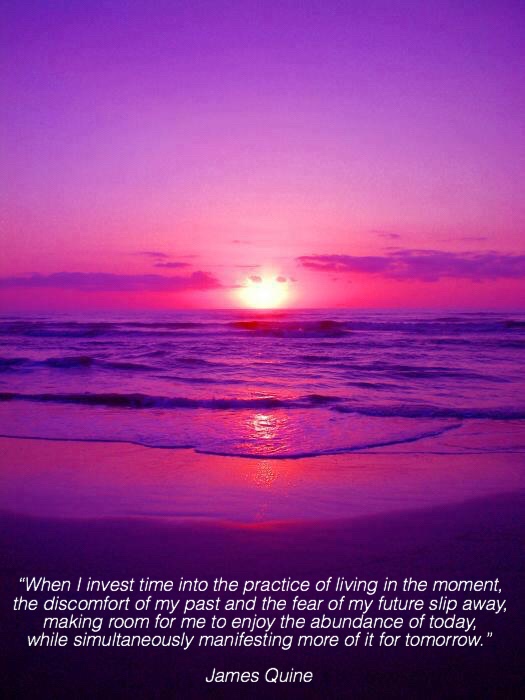
But when I invest time into the practice of living in the moment, the discomfort of my past and the fear of my future slip away, making room for me to enjoy the abundance of today, while simultaneously manifesting more of it for tomorrow. And when that happens, you can bet your bottom dollar that ILML!

— JamieQ

Minding my Business

Minding my Business

“… when my thoughts begin with “He should” or “She shouldn’t” I am probably in trouble.” – Courage to Change

The compulsion to focus on other people is at least as powerful of an obsession as an alcoholic’s desire to drink, an addict’s need to use, or a smoker’s urge to light up another cigarette. But while the alcoholic, addict and smoker are often aware of their addiction, the destruction caused by one’s inability to mind their own business is often not so apparent.

And, in this regard, the suggestion my program offers, to be of maximum useful service to my fellows, can potentially both encourage and justify my intervention. So why is this behavior so harmful?

Because nobody likes being controlled, told what to do or having unsolicited opinions given to them. I can tell you that’s especially true for me. So, why then do some of us continue to try to manage, direct and control the opinions, actions and words of others, knowing we ourselves don’t like it?

One reason for me is that I’m also addicted to being the hero. As a child I got reprimanded for doing something wrong and rewarded for helping out. Those accolades and pats on my back continued into my adult life, reinforcing my desire to help, fix or save someone from themselves or others. So what should I do? Help or not help?

I’ve learned that the best practice is to help others when asked, provided they are unable to help themselves, and that I’m truly able to positively contribute to the situation.

The easiest way to do this is to simply ask “Would you like my opinion (help, advice, etc)?” before giving or doing it. An example is when I’m a passenger in a car. If I know the driver is going the wrong way, I can ask “Would you like some help on how to get there?” If they say no, I say “Ok”, and let the process unfold. Simple, but not so easy.

However, by allowing others to make their own mistakes and find their way gives them both the respect and dignity to overcome their own obstacles and achieve success for themselves, without my intervention. They get to be their own hero,

You’d think that knowing and understanding all of this would keep me from offering unsolicited advice, right? Wrong. A day doesn’t go by when I don’t think “He should” or “She shouldn’t.” And I still occasionally find myself going beyond thinking and actually opening my mouth.

The good news is I’m doing it less often these days. Doing the Daily Deal makes me aware of how I want to behave in my interactions with others and encourages me to be the best man I can be. When I practice these principles in all my affairs, I play much better with others and… ILML!

— JamieQ

The Great Man Move

“…practice these principles in all our affairs.” – Alcoholics Anonymous aka The Big Book, Step 12

We can remain sober and/or in recovery, have a sponsor, sponsor others, go to meetings, pray, meditate, and hold service commitments while not practicing the principles in all our affairs. Will we be loving life? Likely not. In fact, I’ve known many who did all this and were absolutely miserable.

So let’s get into solution and put this another way. If we are sober and/or in recovery, have a sponsor, sponsoring others, going to meetings, praying, meditating, and/or holding service commitments but still not loving life, chances are that the solution is to start actively practicing these principles in all our affairs.

So what exactly are these principles? Well, Bill W. actually considered each step to be a spiritual principle in and of itself. But to simplify them, we can quote the following list posted by others on the web:

Honesty, hope, faith, courage, integrity, willingness, humility, love, discipline, perseverance, spirituality and service.

Not a bad bunch of traits to have associated with you, when you think about it.

Imagine a person asking what kind of person you’re like, and the other person say that your honest, have great integrity, are very loving, hard working, always willing to lend a hand, courageous, have tremendous faith and optimism that things will always work out for the best, very disciplined in your commitments, always hope for the best, have a deep spiritual connection in life, and seem to always persevere and come out on top.

Personally, I’d love it if people described me that way. In fact, it’s one of my goals.

To the men I sponsor I say that practicing the principles in all your affairs can also be called “making the great man move” or being a “great man”. By living in this way, we become wonderful, dependable, kind, contributing humans who utilize the abundance of tools the program gives us to positively alter our thinking, words and actions. And it’s not only others who benefit from this new way of living, which seems to always require that I pause before reacting, it’s me too.

Can we do it every time without fail? Of course not, we’re human. But we can continually up our game, become more aware of when we’re not doing it (hint:we feel bad afterward), and then make amends, learn from the experience, and continue to improve.

As an example, I’m don’t always make the “great man” move, but I do it more than I ever have at any time in my life. And I think that’s a great goal to shoot for.

Today, one thing is for sure. When I do actively practice, in all my affairs, the principles that I’ve described above… ILML!

— JamieQ